Give Internationally
WHY GIVE INTERNATIONALLY?
It is a common question: Why give to communities I don’t see, when the community right in front of me is needy?
Most donors want to see tangible impacts of their donor dollars and be assured that what they are giving makes a difference. This is reasonable and makes perfect sense. But sometimes there are less visible factors that might compel us to see the needs of people beyond our first border and be moved to meet “less seen needs” in effectual ways. Let’s unpack a few reasons why we might give beyond our borders.
The Charities Aid Foundation (CAF) World Giving Index (2024) showed that 78% of U.S. donors give locally and 6% give at the international level. The main reason cited was that donors want to: 1) see the people that they are helping; and 2) know that their contributions make a genuine difference. These are important aspects of charitable giving both locally and globally, so we will return to these criteria as we move forward with this post.
REASONS TO GIVE INTERNATIONALLY
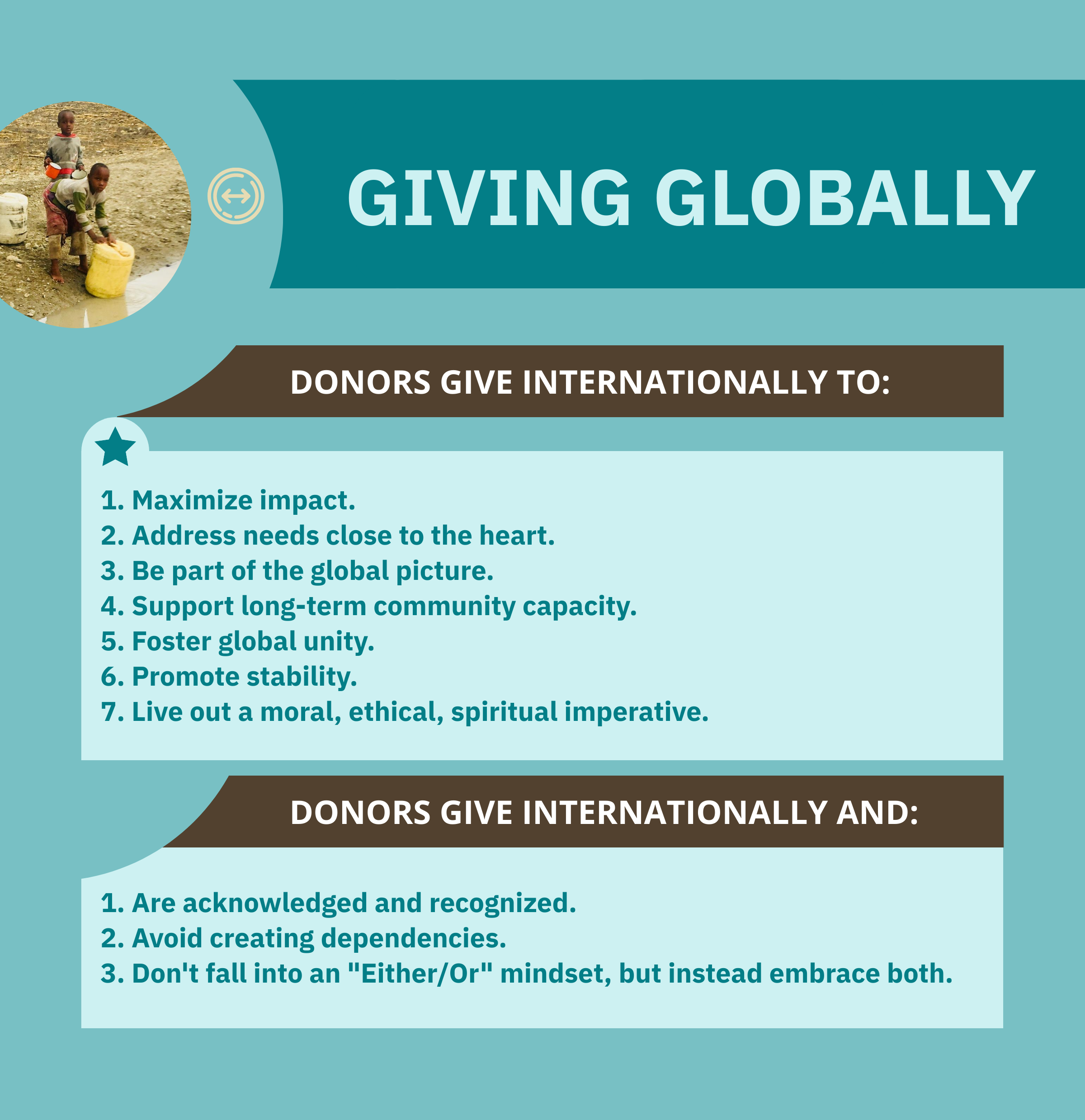
·Maximize Impact.
The value of the U.S. donor dollar (USD) compared to the local currency of developing communities ensures greater impact of one’s gifts. Purchase power of the U.S. dollar can achieve much more in developing communities where the costs of materials, services, goods, labor and infrastructure development are lower. Giving internationally potentially accomplishes more and helps a greater number of people than locally due to the purchasing power of the U.S. dollar. Donors can move the needle.
Address Needs Close to the Heart.
Many donors are interested in critical issues such as education, disease, clean water, poverty, climate, and humanitarian crises, to mention a few. They already share values with charities working internationally. If familiar, they may resonate with the impacts of those charities. Giving internationally can extend a donor’s existing interest in critical issues locally and globally.
Be Part of the Global Picture.
People in wealthier countries already benefit from global newsfeeds, international travel, world-wide communication platforms, professional connections, and merchandise from around the world. Regardless of loyalty to one’s own nation, its products, efforts and people, global context is undeniable. Donors who give internationally can feel greater engagement with existing bridges to the rest of the world, which may, in turn, benefit the donor and the donor’s circles of influence.
Support Long-Term Community Capacity.
Donating to organizations that work internationally builds upon local expertise that can provide culturally appropriate, effective, and sustainable solutions. International donors can have a significant hand in providing sustainable, long-term community capacity building. Strong global communities tend to offer more stable environments where residents are apt to remain and serve instead of fleeing to other areas in search of stability and prosperity.
Foster Global Unity.
Donor Psychology has revealed that giving to charities globally builds empathy and promotes a sense of shared humanity. Donors who give internationally tend to see humans as interconnected and feel mutually responsible for shared understandings and collaborations. Global givers can enhance positive global solidarity, which is a precursor to supportive activity, mutual aid, and stronger institutions.
Promote Stability.
Helping countries develop infrastructure, address poverty, health, education and crises can ease conflicts, prevent diseases, improve lives, and bring about a more stable world for everyone. International donors can make the world a stronger and safer place.
Live Out a Moral, Ethical or Spiritual Imperative.
While specific methods vary, all moral models and major world faith traditions carry the common thread to help those in need. Most humans sense some moral prompting to use their resources to help others who are facing hardships of some kind. Global givers can leverage their resources to improve lives globally, and in turn, feel right about themselves, their contribution and role in the larger landscape.
Barriers to Giving Globally
Donor Recognition.
Not all donors seek a plaque or a name on a building, but some want tangible recognition of their giving and legacy. Local channels put a donor’s name in front of people in the community, which can lead to reciprocity and acknowledgement by the community. Giving internationally requires more data, transparency and evidence-based reports that do not always announce donor names in front of people they know. Donors who give internationally are sometimes content knowing that they are part of a larger effort and that what they gave contributed to someone’s brighter tomorrow.
Dependency.
Donors have a legitimate concern that giving internationally can lead to overreliance of a developing community on outside sources for their well-being. It follows that donors need to work with global nonprofits that demonstrate solid understanding of the complexities of developing communities. Donors are careful to give to nonprofits that empower global communities, not carry out tasks that the communities can do for themselves, and that share resources in ways that strengthen, not inadvertently weaken the community they hope to serve. International donors can support efforts that boost dignity within developing countries by adhering to principles of sound giving.
The False Dichotomy of “Give Here” OR “Give There”.
It is a false dichotomy to ‘give here’ OR ‘give there’. This either/or thinking is grounded in a mindset that ignores the current connectedness of the world. There is no real reason to do only one. Global givers can easily do both.
In Summary
Donors are encouraged to give both domestically and globally. Giving locally is imperative to the health of our communities. Giving globally is imperative to the wellbeing of our world. If all people are created equal, then charities that help people in need, both domestically and internationally, are equally important.
There is a great sense of fulfillment when a global giver 1) sees the people that they are helping; and knows 2) that their contributions make a genuine difference. These are important aspects of charitable giving and happen ubiquitously in both local and global charity work. Perhaps it boils down to “who we see” and “how we see them”.
People give internationally because they see the dignity and needs of people, globally; and because they are convinced that their donations make a tangible difference. Each charity must convince donors that their mission is clear, worthy, and that their donations make a difference in real lives of real people. Why limit your compassion? Why limit your reach? Join us as we give a hand up (not a hand-out) in this big ol’ world, and help the people of Karagwe lift themselves out of poverty.